
What is TESA?
TESA (Testicular Sperm Aspiration) is a minor surgical procedure where sperm is collected directly from the testicle using a fine needle — used when sperm cannot be found in semen through normal ejaculation. Sperm retrieved through TESA is then used for ICSI or IVF treatment.
- Men diagnosed with azoospermia (no sperm found in semen)
- Obstructive male infertility due to blocked sperm ducts
- Failure to obtain sperm through normal ejaculation
- Retrograde ejaculation, where semen flows backward
- Men advised TESA as part of IVF or ICSI treatment planning
TESA is a safe, minimally invasive procedure performed under local anaesthesia with quick recovery when done by experienced fertility specialists.
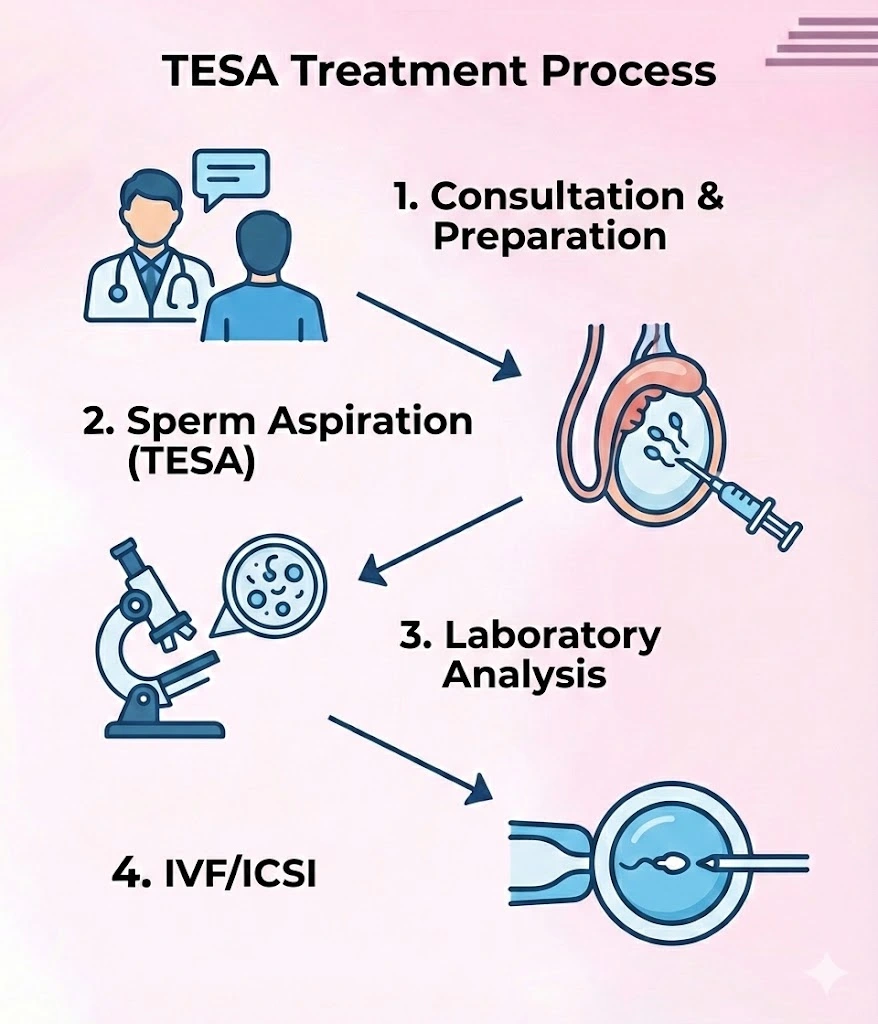
TESA Procedure — Step by Step
Local Anaesthesia
The testicular area is numbed so the procedure is largely painless.
Fine-Needle Aspiration
A thin needle is inserted into the testis to draw out a small tissue/fluid sample.
Lab Examination
The sample is examined under a microscope to identify viable sperm.
Sperm Preparation
Viable sperm is prepared for immediate or future use in ICSI/IVF.
Same-Day Recovery
Most patients go home the same day with minimal downtime.
At Diwya Vatsalya Mamta Fertility Centre, TESA is performed under the supervision of Dr. Rashmi Prasad — MBBS, DGO, DNB, PG-ART (University of Kiel, Germany), 25+ years of experience.
TESA Treatment Cost in Patna
TESA is usually done as part of a fertility plan rather than on its own. The exact cost is decided only after proper examination and consultation with the fertility specialist.
| Procedure | Approximate cost | When it applies |
|---|---|---|
| ⚕️TESA (standalone procedure) | ₹18,000 – ₹23,000 | Sperm retrieval done on its own, without a linked IVF cycle |
| 🔬TESA / TESE with ICSI | ₹25,000 – ₹35,000 | Retrieval combined with an ICSI cycle — the usual route in azoospermia |
| 🧬ICSI cycle (the treatment TESA feeds into) | ₹1,10,000 – ₹1,20,000 | Retrieved sperm is injected directly into the egg |
*The exact cost is decided only after examination. For an accurate estimate, book a consultation with our team.
Why there are two figures
TESA on its own costs less than TESA carried out alongside an ICSI cycle, where the retrieved sperm is used immediately in the laboratory. Which one applies to you depends on your treatment plan.
What changes the figure
Your individual medical condition, the anaesthesia and lab work required, and whether the sperm is used fresh or frozen for later all affect the final number.
Ask before you commit
Azoospermia is frightening to hear, and it is easy to agree to anything in that moment. Take the written estimate, ask what each line is for, and decide without pressure.
TESA vs TESE vs micro-TESE — Choosing the Right Procedure
These three surgical sperm-retrieval techniques are close cousins — each suits a different diagnosis. Understanding the difference helps you have an informed conversation with your specialist.
🩺 TESA (Aspiration)
A fine needle draws fluid and sperm from the testicle. Done under local anaesthesia in about 30 minutes. Best suited to obstructive azoospermia where production is normal but the pathway is blocked.
🩺 TESE (Extraction)
A small tissue sample is taken from the testicle when TESA does not retrieve enough sperm. Used when the cause is less clear-cut, or when more tissue is needed for laboratory processing.
🔬 micro-TESE (Microsurgical)
Uses an operating microscope to identify healthy sperm-producing tubules and remove a very small, targeted piece of tissue. Preferred choice for non-obstructive azoospermia, where sperm production is patchy.
👉 Which Suits You
Diagnosis, hormonal profile and prior surgical history decide the choice — not price. Discussed openly with our fertility specialist before your procedure day is set.
TESA Success Rates & What To Expect
Sperm-retrieval success depends more on the underlying cause of azoospermia than on the technique itself. Realistic numbers help set expectations.
🎯 Obstructive Azoospermia
Sperm retrieval is successful in 90%+ of cases. Since production is normal, TESA usually finds usable sperm on the first attempt.
🎯 Non-Obstructive Azoospermia
Retrieval success is 40–70% depending on hormonal profile and previous testicular history. micro-TESE typically outperforms TESA in these cases.
👶 Live Birth When Combined With ICSI
Once viable sperm are retrieved, live-birth rates via ICSI depend mainly on the female partner’s age and egg quality — similar to standard IVF outcomes for that age group.
🧊 Sperm Freezing
Retrieved sperm can be frozen (vitrification) for future cycles. This means one procedure can support multiple ICSI attempts, avoiding repeat surgery.
After TESA — Recovery & Next Steps
Recovery is straightforward for the vast majority. Knowing what to expect makes the process much less daunting.
🩹 Immediate Recovery
Mild soreness and swelling for 1–3 days. Ice packs and simple pain relief manage discomfort. Most men return to desk work the next day; heavy work in a week.
⚠️ Warning Signs
Significant swelling, fever, heavy bleeding or worsening pain after 48 hours needs same-day medical review. These are uncommon but not to be ignored.
🚫 What To Avoid
Heavy lifting, cycling and hot tubs for 1–2 weeks. Sexual activity typically resumed after 7–10 days depending on healing.
📅 Next Steps
Retrieved sperm is either used fresh for the female partner’s planned ICSI cycle or frozen for later use. Timing is coordinated between the male and female treatment plans.
TESA is one step in the broader male infertility treatment pathway — not the whole answer. Diagnosis, female-partner readiness and ICSI timing all matter together.
TESA Treatment FAQs
TESA is a procedure used to collect sperm directly from the testicles when sperm is not found in semen.
No, TESA is done under local anaesthesia and usually causes only mild discomfort.
It is advised for men with azoospermia, very low sperm count, or blocked sperm passage.
The procedure usually takes about 15–20 minutes and is done on the same day.
Yes, sperm collected through TESA can be used for IVF or ICSI treatment.
Diagnosed with Azoospermia?
Free first consultation with Dr. Rashmi Prasad · 4.9★ from 1,986+ Reviews · 65,000+ Families Helped