
Most people don’t decide to see a fertility specialist overnight. It usually begins with a quiet question that keeps returning: we have been trying for a while — is it taking too long? Should we wait a bit more, or ask for help?
Those thoughts are normal. The journey to pregnancy is different for every couple, and needing a little more time doesn’t automatically mean something is wrong. But there are situations where an expert opinion at the right moment can genuinely change what happens next — and where early testing helps identify treatable causes before more time is spent trying alone.
If you have been wondering when to see a fertility specialist, this guide explains the recommended timelines, the five warning signs that shouldn’t be ignored, and what actually happens at your first appointment.
How Long Should You Try Before Seeing a Specialist?
One of the most common questions couples ask is how long they should keep trying before booking a consultation. The honest answer depends largely on age, because fertility changes over time.
| Your age | When to consult a specialist | Why this timeline |
|---|---|---|
| Under 35 | After 12 months of trying | Most healthy couples conceive within a year; medical review after that helps rule out treatable causes. |
| 35 – 39 | After 6 months of trying | Egg quantity and quality decline with age; earlier assessment keeps more treatment options open. |
| 40 or older | Before you actively start trying | Preconception counselling and ovarian reserve testing help you plan without losing time to a wait. |
| Any age, with a known condition | Sooner — do not wait the full window | PCOS, endometriosis, thyroid disorders and prior surgery can affect conception from the start. |
If you’re under 35
If you have been having regular, unprotected intercourse and have not conceived after 12 months, it is a reasonable time to see a fertility specialist. Many healthy couples take several months to conceive, so waiting a year is not usually a cause for panic. A medical review afterwards helps identify whether anything treatable is affecting conception.
If you’re 35 or older
The general advice for women aged 35 and above is to seek medical review after 6 months of trying. This shorter window is not meant to add pressure — it reflects the fact that fertility gradually declines with age, and earlier assessment gives more treatment options if something is found.
If you’re 40 or older
For women aged 40 and above, specialists usually suggest a consultation before you actively begin trying. This appointment focuses on preconception counselling, ovarian reserve testing, and understanding your reproductive health — so you can make informed decisions without spending time waiting unnecessarily. If you’d like context on how age influences success, read our guide on the best age for IVF treatment.
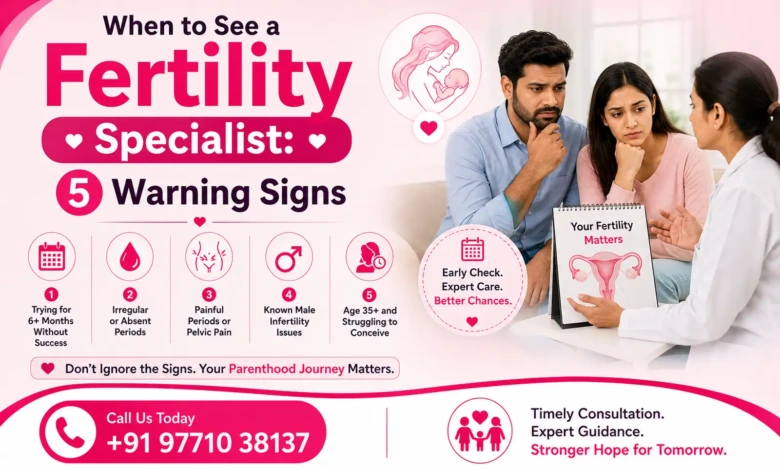
5 Warning Signs You Shouldn’t Ignore
Sometimes, timing alone isn’t enough — certain conditions can affect your fertility regardless of how long you have been trying. Recognising these signs early lets your doctor investigate the likely causes and suggest the right next step.
1. Irregular, Very Long, or Absent Periods
A regular menstrual cycle usually indicates that ovulation is happening consistently. When periods become very irregular, vary greatly in length from month to month, or stop altogether, it may signal that ovulation is not occurring as it should.
Most cycles fall between 25 and 30 days. Some women go several months without a period, and both extremes are worth a medical review — especially if pregnancy is the goal. Unpredictable cycles can have many causes, including hormonal imbalance, polycystic ovary syndrome (PCOS), thyroid disorders, high stress, dramatic weight changes, or early ovarian insufficiency.
Very heavy or very painful periods shouldn’t be ignored either. Some discomfort is normal, but severe pain may point to conditions such as endometriosis, which can affect fertility if left untreated.
2. Two or More Pregnancy Losses
Miscarriage can be a heartbreaking experience. Reassuringly, one early miscarriage is fairly common and does not usually mean there is a problem conceiving again — many women go on to have healthy pregnancies afterwards. But two or more pregnancy losses is a signal that further evaluation is worthwhile.
Recurrent pregnancy loss can be caused by a number of conditions, several of which are treatable:
- Hormonal imbalances
- Uterine abnormalities
- Chromosomal factors
- Blood-clotting disorders
- Thyroid disease
- Autoimmune conditions
A fertility specialist can investigate these possibilities through targeted tests and recommend a treatment plan based on the underlying cause. Seeking help after recurrent loss isn’t about expecting the worst — it’s about understanding what happened and improving the chances of a healthy pregnancy next time.
3. A Known Condition Such as PCOS, Endometriosis, Thyroid Disorder or Fibroids
Certain health conditions are known to affect fertility even before you start trying. If you have already been diagnosed with one of them, an early conversation with a fertility specialist can help you plan treatment better rather than waiting.
Polycystic Ovary Syndrome (PCOS)
PCOS is one of the most common causes of irregular ovulation. It can lead to irregular periods, acne, excess facial hair and weight gain. Because ovulation is inconsistent, conception often takes longer without treatment. Early management usually improves both ovulation and pregnancy rates. Our guide to PCOD in Hindi explains the condition, symptoms and treatment options in more detail.
Endometriosis
Endometriosis occurs when tissue similar to the lining of the uterus grows outside it. It can cause:
- Severe menstrual pain
- Pain during intercourse
- Chronic pelvic pain
- Difficulty conceiving
It can affect egg quality, damage the fallopian tubes or interfere with implantation, which is why early diagnosis is especially valuable.
Thyroid Disorders
An underactive thyroid (hypothyroidism) or overactive thyroid (hyperthyroidism) can disrupt ovulation and the menstrual cycle. In most cases these conditions are treatable with medication, and restoring hormonal balance often improves fertility. For deeper context, see our article on thyroid and pregnancy.
Uterine Fibroids
Fibroids are non-cancerous growths in or around the uterus. Not all fibroids affect fertility, but depending on their size and position they can interfere with implantation or increase the risk of miscarriage. Read our detailed guide on बच्चेदानी में गांठ (fibroids) for symptoms and treatment options. Your specialist will decide whether treatment is needed before you try to conceive.
Whether you have already been diagnosed with one of these conditions or suspect you may have one, discussing your next steps with a fertility expert is more useful than waiting through several unsuccessful months of trying.
4. Male-Factor Signs — Not Just a Woman’s Checklist
Fertility is often thought of as a woman’s issue, but that isn’t accurate. Nearly half of all infertility cases involve a male factor — either alone or alongside female factors. That is why both partners should be evaluated from the start, rather than waiting until every female test has been completed.
Most male-factor issues have no obvious outward symptoms, which is why the first investigation usually suggested is a semen analysis. It is fast, non-invasive and gives important information about sperm count, motility, shape and overall health.
It’s worth seeing a specialist sooner if your partner has any of the following:
- A previously diagnosed low sperm count or poor sperm motility
- A history of testicular injury, infection or surgery
- Varicocele (enlarged veins in the scrotum)
- Undescended testicles during childhood
- Previous chemotherapy or radiation treatment
- Erectile or ejaculation difficulties
- No previous semen analysis, despite trying to conceive for several months
Sometimes, identifying and treating a male-factor issue can significantly improve the chances of pregnancy without moving straight to advanced fertility treatment. A modern fertility evaluation always considers both partners together, so no potential cause is missed.
5. You’re 35+ (or 40+) and Haven’t Conceived Yet
Age affects fertility, particularly in women. Many people do conceive naturally in their late 30s and early 40s, but egg quantity and quality decline over time.
If you are over 35 and have been trying for 6 months without success, it is a good time to consult a fertility specialist. If you are 40 or above, a consultation is helpful even before you actively begin trying — it lets your doctor assess ovarian reserve, review your reproductive health and suggest an approach suited to your situation. Seeking advice early doesn’t mean something is wrong. It simply gives you more options while there is more time to consider them.
Does Seeing a Fertility Specialist Mean You Need IVF?
No. Seeing a fertility specialist does not automatically mean IVF. This is one of the biggest myths that stops couples from seeking help.
The purpose of a first consultation is to understand why pregnancy has not happened yet — not to prescribe IVF at first sight. Many fertility issues respond to much simpler treatments, including:
- Identifying the fertile window more accurately
- Lifestyle and nutritional changes
- Treatment for thyroid disorders or hormonal imbalances
- Ovulation-inducing medication
- Managing PCOS or endometriosis
- Treating mild male-factor infertility
- Intrauterine insemination (IUI), when appropriate
IVF is only recommended when it offers the best chance of pregnancy for a given diagnosis. Early assessment often leads to reassurance, simple treatment, or an IUI plan — well before IVF is even a consideration. If you’d like to compare the two, read our guide on IVF vs IUI — differences and cost.
What Happens at Your First Fertility Consultation?
Many people delay their appointment simply because they don’t know what to expect. The first visit is usually a relaxed conversation focused on understanding your medical history and fertility goals. There are no urgent procedures or decisions unless they are clearly needed.
During your visit, Dr. Rashmi Prasad will typically discuss:
- How long you have been trying to conceive
- Your menstrual cycle pattern
- Previous pregnancies or miscarriages
- Any existing medical conditions
- Current medications
- Lifestyle factors such as weight, smoking or stress
- Your partner’s medical history
Depending on your situation, your doctor may suggest a few basic investigations:
- Hormone blood tests
- Pelvic ultrasound
- Ovulation assessment
- Semen analysis
- Additional tests, if clinically indicated
Once the reports are in, Dr. Rashmi Prasad explains the findings in plain language and discusses the next steps with you. The goal is to help you make informed decisions — not to overwhelm you with medical terminology.
What to Bring to Your Appointment
To make the consultation as useful as possible, bring:
- Previous blood test reports
- Ultrasound reports
- Any fertility investigations already completed
- Details of previous treatments or medications
- Records related to earlier pregnancies or miscarriages, if available
Having these documents on hand avoids repeating tests unnecessarily and helps your doctor understand your fertility journey more quickly.
Quick Self-Check — Is It Time to See a Specialist?
If you answer “yes” to any of the following, it is worth considering a consultation with a fertility specialist.
- You are under 35 and have been trying to conceive for 12 months or longer.
- You are 35 or older and have been trying for 6 months or longer.
- You are 40 or older, even if you haven’t started trying yet.
- Your periods are irregular, absent, unusually heavy or very painful.
- You have experienced two or more pregnancy losses.
- You or your partner have a diagnosed condition such as PCOS, endometriosis, thyroid disease, fibroids or varicocele.
- Your partner has never had a semen analysis.
- You are worried about your fertility and would like professional guidance before waiting any longer.
This checklist isn’t designed to diagnose infertility. It simply helps identify situations where a specialist evaluation may give you useful answers.
Fertility Specialist Care in Patna — What to Expect at Our Centre
Choosing a fertility clinic is about more than treatment options. It is about finding a team that listens carefully, explains every step clearly, and creates a plan that suits your situation.
At Diwya Vatsalya Mamta Fertility Centre in Patliputra Colony, Patna, every patient receives a personalised fertility assessment before any treatment is recommended. Under the guidance of Dr. Rashmi Prasad, who has over 25 years of experience in reproductive medicine, the centre has supported more than 65,000 patients since 2010, with an overall IVF success rate exceeding 75% across patients treated.
Whether you’re trying to conceive naturally, exploring fertility investigations or considering assisted reproductive treatment, the first consultation is designed to answer your questions — not to rush you into a particular procedure.
Take the Next Step at Your Own Pace
Talk to Dr. Rashmi Prasad’s team about your concerns in a comfortable, supportive environment. The first consultation is a conversation — not a commitment.
Final Thoughts — Don’t Wait Longer Than You Need To
If you have found yourself wondering when it might be time to think about a fertility consultation, you are not alone. Many couples spend months debating whether to keep trying or to book an appointment. Taking that first step doesn’t mean something is wrong — it means you have decided to understand your reproductive health with the guidance of a qualified specialist.
Early evaluation often uncovers issues that can be addressed with medication, lifestyle changes, ovulation therapy or other non-invasive approaches. And if more advanced fertility treatment is eventually needed, seeking help sooner keeps more options open and makes the road ahead clearer. Sometimes the most helpful thing is simply knowing where you stand before you take the next step on your fertility journey.
When should I see a fertility specialist if I’m under 35?
If you are under 35 and have been having regular, unprotected intercourse for 12 months without conceiving, it is a good time to consult a fertility specialist. If you have irregular periods, PCOS, endometriosis or another known reproductive condition, it is sensible to seek advice sooner rather than waiting the full year.
Does seeing a fertility specialist mean I need IVF?
No. A fertility consultation is not an automatic step to IVF. Its purpose is to understand why pregnancy has not happened. Many couples conceive after treatment for hormonal imbalance, ovulation induction, correction of male-factor infertility, lifestyle changes or intrauterine insemination (IUI). IVF is recommended only when it clearly offers the best chance for a given diagnosis.
What tests happen at the first fertility consultation?
The first appointment usually starts with a medical history covering your menstrual cycle, past pregnancies, medications and lifestyle. Depending on your situation, your doctor may recommend a pelvic ultrasound, ovulation assessment, hormone blood tests or a semen analysis for your partner. Not every test is needed for everyone — the evaluation is tailored to your specific circumstances.
Should men also be tested, or only women?
Yes, men should be evaluated too. Male factors contribute to nearly half of all infertility cases, so specialists usually recommend assessing both partners from the start. A semen analysis is one of the least invasive and most informative early investigations, and it is a routine part of the workup.
Is one miscarriage a sign of infertility?
Not necessarily. A single early miscarriage is relatively common and does not usually indicate infertility. However, two or more miscarriages is a signal to consult a fertility specialist so that treatable causes such as hormonal, uterine, clotting or thyroid issues can be investigated.
What if I’m over 40 and haven’t started trying yet?
If you are 40 or older and hope to conceive, it is sensible to see a fertility specialist before you begin. A preconception visit assesses ovarian reserve, reviews your general reproductive health and past medical history, and helps you understand your realistic options — so you can plan without spending time waiting.
Disclaimer
This article is for general information and awareness only — it is not a substitute for professional medical advice. Every patient's situation is different; always consult a qualified doctor before making any treatment or medication decision. For a free consultation at Diwya Vatsalya Mamta Fertility Centre, Patna, call +91 97710 38137.
✓